Anyone can claim AI.Engineering must prove it.
iDrillWell products unite first-principles physics, engineering workflows and governed agents—so every recommendation can be examined, challenged and acted upon.
Can one well model connect design, risk, operations and economics?
GeoWellSuit turns fragmented specialist calculations into one coordinated engineering environment—comprehensive underneath, simple at the decision surface.
GeoWellSuit
Comprehensive engineering. One clear operating view.
GeoWellSuit connects well geometry, drillstring, fluids, transient solvers, finite-element models and specialized agents in one traceable workspace. Engineers can work directly in Manual Mode or collaborate with AI Assist through Ask, Analyze, Autopilot and RoboDWOP—without surrendering assumptions, methods or engineering judgment.
- One Well Canvas for surveys, hole sections, strings, fluids and lithology
- Twelve coordinated engineering disciplines around a shared well state
- Operating envelopes that expose performance, stability, cost and risk together
- Physics-led recommendations with visible provenance and sensitivities
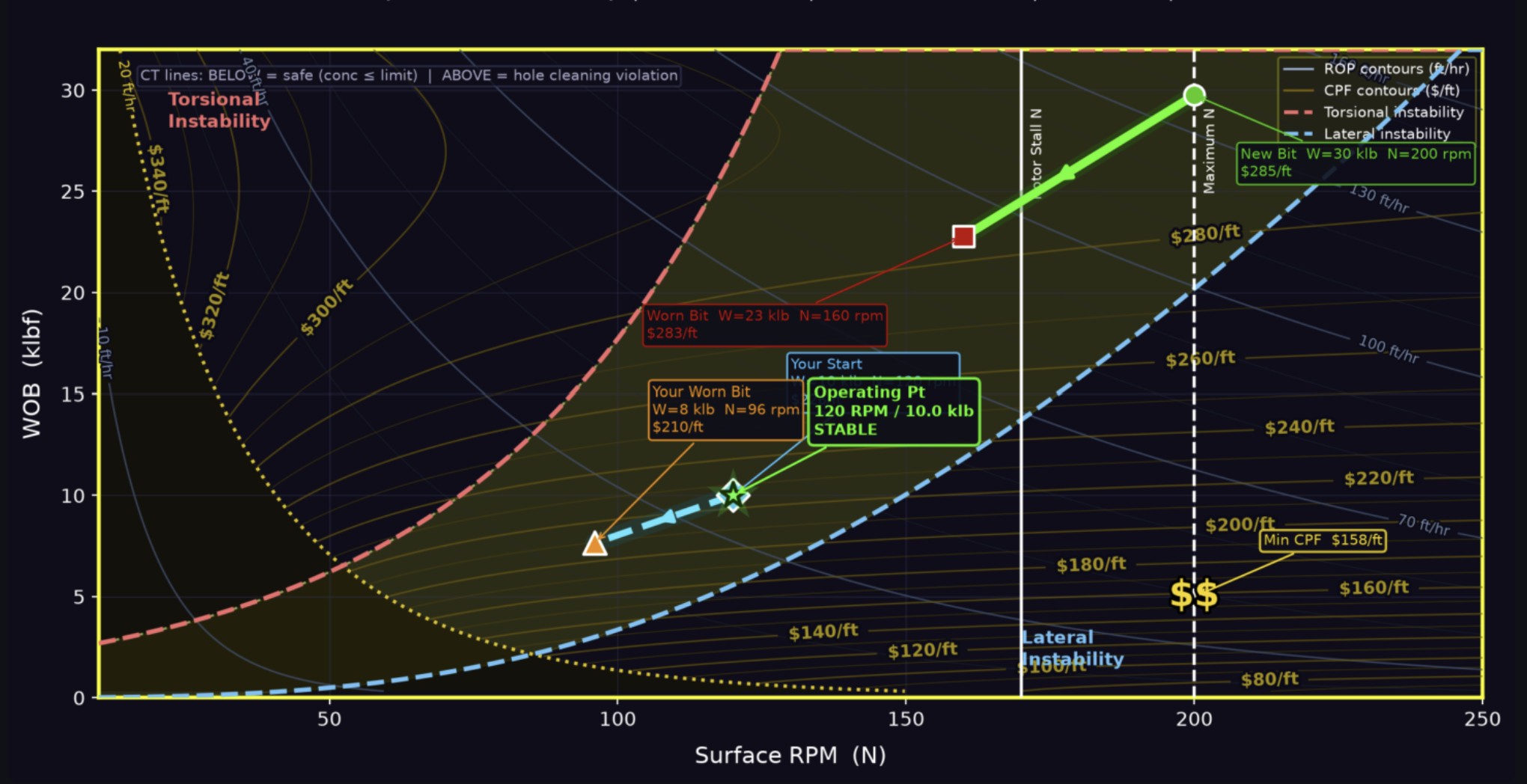
Every major well decision, connected.
Each module can run independently. Together they share the same well definition, operational context and engineering evidence—eliminating handoff gaps between isolated calculations.
Hydraulics Analysis
Transiently calculates optimum pressure loss, bit hydraulics and hole-cleaning parameters for efficient circulation.
Torque & Drag
Models transient drillstring and casing forces across operating scenarios to prevent overload and optimize the well path.
BHA Dynamics
Uses finite elements to predict critical speeds and lateral, torsional and axial oscillations at low and high frequencies.
BHA Mechanics
Uses finite elements to predict directional tendencies and locate high-stress regions within the bottomhole assembly.
Stuck Pipe
Identifies the sticking location and calculates back-off and jar-firing forces required to free the string.
Swab & Surge
Predicts transient pressure changes from pipe movement to avoid influx and formation fracture during tripping.
Underbalanced Hydraulics
Models transient multi-fluid behavior to control downhole pressures while drilling below formation pressure.
Well Control
Evaluates transient kick tolerance and automates kill-sheet calculations for safe influx-pressure management.
Casing Design
Models HP/HT conditions, thermal loads and annular pressure buildup across multi-string systems.
Casing Wear
Predicts and visualizes 3D casing-wall reduction from drillstring rotation and tripping.
Directional Planning
Optimizes trajectory by balancing torque, drag, cost and anti-collision safety margins.
Survey Data Management
Processes real-time and historical survey data for accurate, auditable 3D wellbore placement.
Not a generic BHA. Every tool can carry its own physics.
GeoWellSuit couples comprehensive tool-level finite-element and transient models with the full BHA response—capturing interaction, loading, motion, energy transfer and operational limits across the assembled system.
What happens when gas migration outruns the wireline trip?
GasMig converts a high-consequence timing problem into an explainable pre-job decision—before the operation begins.
GasMig
From well data to a defensible GO/NO-GO verdict.
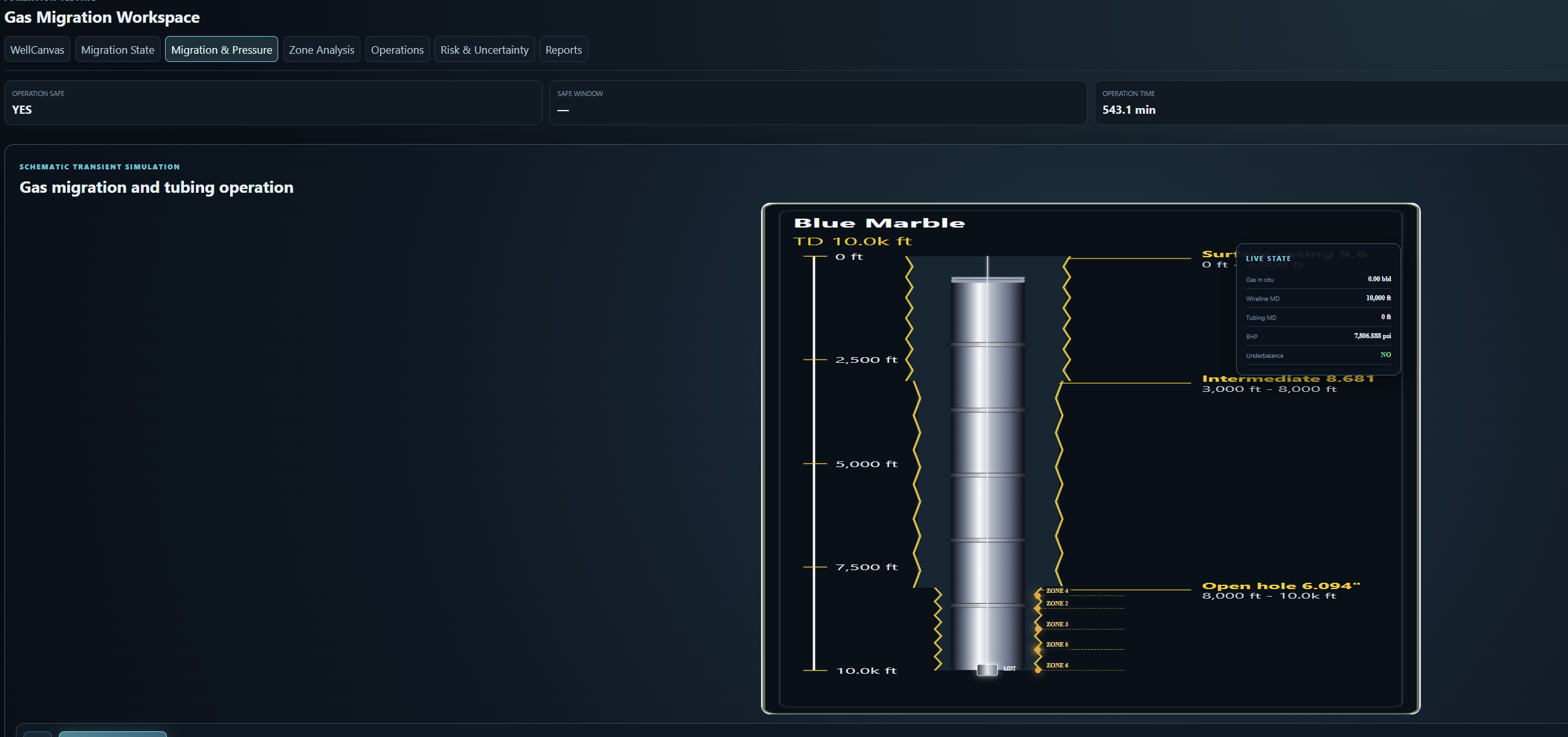
GasMig integrates flexible well setup, transient multiphase and compositional physics, operations-aware sequencing, probabilistic risk analysis and field-ready reporting in one auditable workflow.
- Import EDM/XML, JSON, ADI and XLSX—or build the well directly
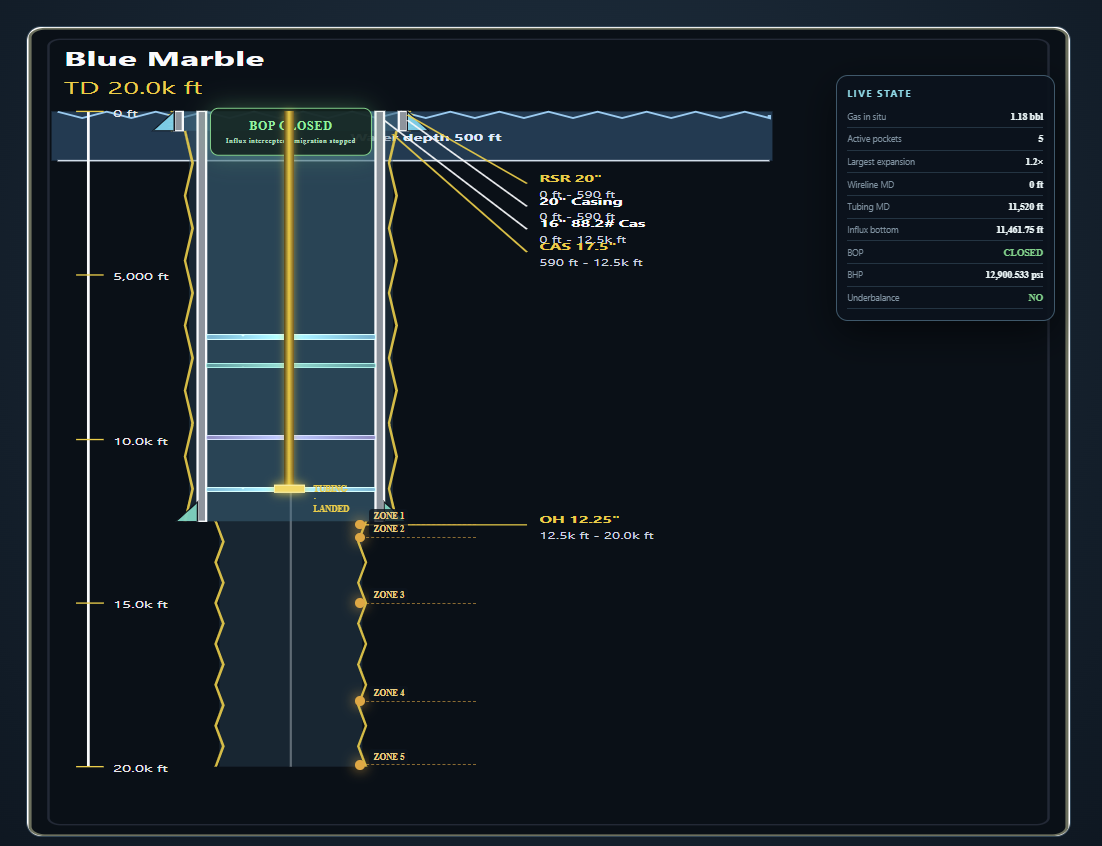
- Simulate influx, expansion, migration, coalescence and connection pulses
- Model wireline POOH, tubing RIH, BOP timing and transient well kill
- Expose the binding constraint and rank operational levers by impact
- Run operating envelopes, Monte Carlo and tornado sensitivities
Not more dashboards. Better engineering decisions.
Physics first
Deterministic engineering remains the foundation; AI accelerates interpretation and workflow.
Explainable
Every verdict exposes the constraint, sensitivity, assumptions and path to a better result.
Operational
Outputs are designed for the engineer, decision-maker and rig crew—not merely for the model.
We’ll bring back an engineering verdict.
See GasMig and GeoWellSuit applied to a real design or operational scenario.