The critical interval is measured in minutes.GasMig turns it into a decision.
GasMig models transient gas migration during wireline testing and connects well data, gas behavior, operational timing and uncertainty in one auditable workflow. It helps engineering teams determine whether the planned sequence is defensible, what constraint controls the outcome and what operational change can improve it.
What happens when gas migration outruns the wireline trip?
Wireline testing can create a narrow interval between the beginning of underbalance and the arrival of gas at surface. During that interval, the crew must retrieve wireline, make connections, run tubing and maintain control of the well. If gas behavior and operational timing are treated separately, the plan can appear safe while critical interactions remain unexamined.
GasMig was developed for this specific decision. It models the well, test zones, fluids, gas composition, operational sequence and transient pressure behavior. It then compares the time required to execute the planned operation with the time available before a defined crisis condition. The output is not only a calculated margin. It is an explainable verdict tied to the controlling zone, event and assumption.
This focused abstraction matters. A hand-built spreadsheet may be fast but can omit transient coupling, gas behavior, rheology, uncertainty and auditability. A general flow-assurance suite may be comprehensive but require specialist setup and an analysis cycle that does not fit rapid pre-job iteration. GasMig is designed for the engineering space between those extremes.
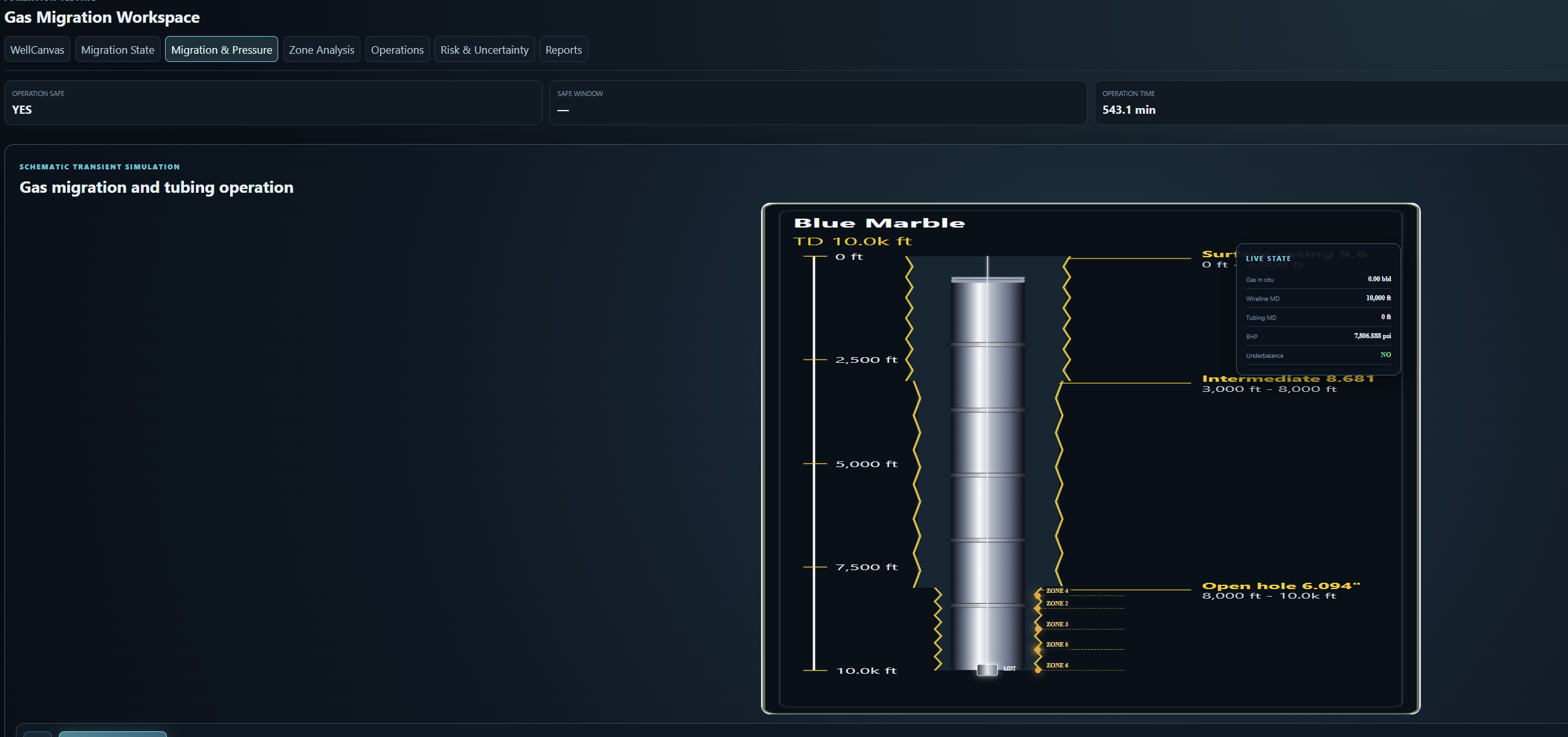
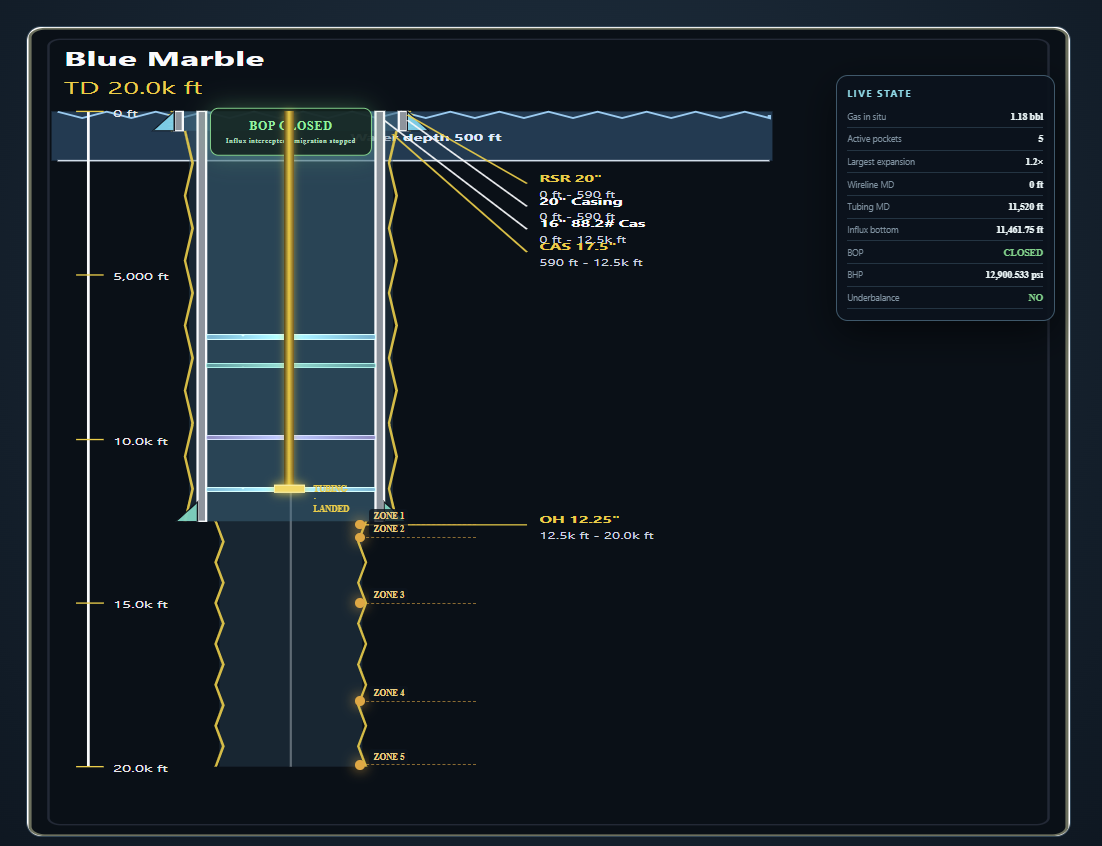
From flexible well data to an operational verdict.
The workflow preserves the relationship among setup, transient physics, operations, risk analysis and field communication.
Construct the actual case
Create the well or import structured inputs such as EDM/XML, JSON, ADI and XLSX. Define trajectory, lithology, hole and casing, pore and fracture pressures, gas composition and test zones. Cases can be saved, reused and compared.
Model coupled behavior
Simulate compositional PVT, pressure response, zone-specific influx, gas-pocket migration, expansion and coalescence. Connect that behavior to wireline POOH, connections, tubing RIH, BOP timing and transient well-kill operations.
Explain the verdict
Review depth and time tracks, bottomhole and casing-shoe pressures, operating envelopes, GO/NO-GO status, binding constraints, Monte Carlo results, tornado sensitivities and auditable PDF or Excel reports.
Engineers need more than a binary margin.
Inputs such as operational speed, connection time, pressure, fluid properties and gas behavior are not perfectly certain. A deterministic margin can therefore change sign when realistic variation is introduced. GasMig expresses the trip-versus-crisis result through a probability of successful completion, P(GO), while retaining the deterministic calculation and uncertainty assumptions beneath it.
The probability does not replace engineering judgment. It helps distinguish a robust plan from one that appears acceptable only because nominal inputs were favorable. Monte Carlo and sensitivity analyses can refine the conclusion, reveal which assumptions dominate the outcome and show where additional data would be most valuable.
A robust plan with P(GO) at or above the selected high-confidence threshold.
A marginal plan in which modest operational or input variation may reverse the verdict.
A high-risk plan that should be revised before execution.
GasMig says why the plan fails—and what can change.
Identify the controlling crisis
Determine whether the plan is controlled by underbalance, gas reaching surface, fracture risk or another defined limit. The event is tied to zone, time and operating step.
Quantify operational levers
Measure how the decision margin responds to connection time, tubing speed, wireline speed and other controllable variables within practical ranges.
Test whether the fix is enough
Rank alternatives by leverage and state honestly when no single practical change is sufficient to reverse the result.
Represent repeated small influxes
Model gas pulses associated with tubing connections rather than assuming zero connection gas throughout the operation.
Continue through well kill
Extend analysis beyond gas-arrival timing to the operational sequence required to restore the well to a safe condition.
Preserve the technical basis
Retain inputs, assumptions, cases, calculations and outputs so the decision can be reviewed before and after the operation.
The toolpusher should not need to operate the model.
A technically sophisticated model is valuable only if its conclusion can reach the people executing the operation. GasMig can convert the analysis into a concise crew briefing containing the verdict, affected zones, binding constraint and principal operational levers. The detailed model remains available to the engineering team, while the rig-floor document focuses on the decision and required action.
This separation supports both audiences. Engineers retain transient plots, sensitivities, uncertainty and the audit trail. The crew receives a clear, controlled summary suitable for pre-job discussion and operational reference. A link or QR code can connect the briefing to the current technical case when more detail is required.
Where GasMig adds decision value.
Pre-job planning
Test the planned wireline and tubing sequence before mobilization. Compare zones, identify critical timing and establish a defensible operating window.
Operational optimization
Evaluate test order, connection practices, wireline retrieval speed, tubing-running speed and contingency options against the controlling risk.
Assurance and review
Provide an auditable technical basis for peer review, management approval, crew briefing and post-operation learning.
Transient physics sized for an operational decision.
GasMig combines compositional fluid behavior, transient pressure response, zone-specific influx, bubble expansion, migration, coalescence and operations-aware timing. It is intended to preserve the physics that materially affects the wireline-testing decision without imposing the setup burden of a general-purpose flow-assurance environment.
The model and workflow draw on extensive professional work in drilling hydraulics, well control, gas behavior, real-time well engineering and operational risk. Technical references, model descriptions, benchmark cases and validation evidence can be reviewed during a customer evaluation. Results should always be applied within company well-control standards, approved operating procedures and qualified engineering review.
Questions engineering and operations teams ask.
Is GasMig a well-control simulator?
It is a focused transient decision tool for gas migration and wireline-testing operations, including relevant pressure behavior, operational sequencing and well-kill evaluation. Its scope should be reviewed against the intended company workflow.
Does it provide only GO or NO-GO?
No. It provides the calculated basis, probability, controlling constraint, affected zone, sensitivities and practical operational levers behind the verdict.
Can it analyze multiple test zones?
Yes. Zone-specific conditions can be evaluated individually and within the planned sequence, allowing engineers to compare test order and cumulative operational consequences.
How quickly can scenarios be compared?
The workflow is designed for rapid pre-job iteration. Representative deterministic and probabilistic cases can be evaluated in seconds, although runtime depends on model scope and analysis settings.
Can customer data be imported?
GasMig is designed to accept structured well information and common engineering exchange formats. Import mapping can be aligned with customer data systems and governance requirements.
How should a company evaluate GasMig?
Select a representative critical trip, provide the available well and operational data, and compare the GasMig verdict, sensitivities and timing against the existing planning method.
Bring us a critical wireline trip. We’ll bring back a verdict.
Evaluate GasMig using a representative well, test sequence and operating plan.
Request a GasMig demonstration